
Arrow Dash Cash
Kashif IqbalCasual
0.00.00 Reviews
- Version
- 202600701-1723
- Installs
- 100.00K
- Age Rating
- Everyone
Screenshots
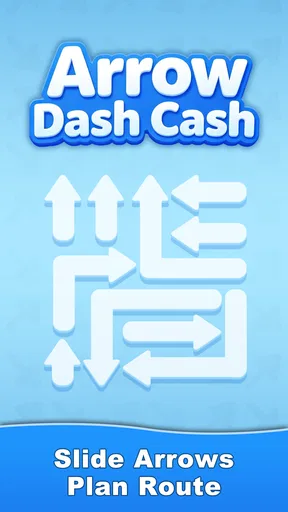
Our Review of Arrow Dash Cash
 Analysis by Appyee
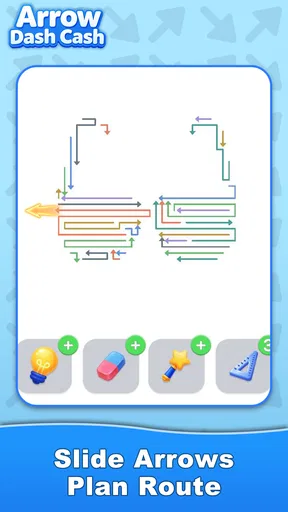
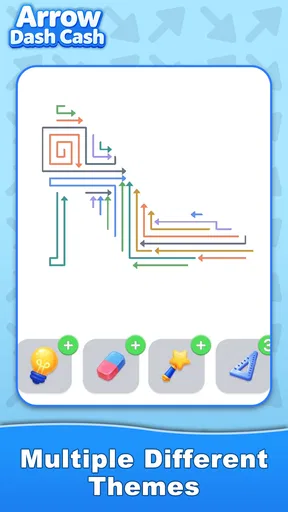
I went into Arrow Dash Cash expecting a quick casual game, and that is exactly where it makes the most sense. Its entire appeal comes from reading the direction of moving arrows, opening a safe route, and choosing an order that lets the board clear instead of collapsing into a blocked mess. That sounds simple, but the small gap between a correct move and a careless one gives each short session a useful bit of tension.
This is a game I would suggest to someone who wants a lightweight puzzle-like distraction rather than a long adventure, competitive multiplayer experience, or story-driven campaign. It is free, rated for Everyone, and developed by Kashif Iqbal. The audience is broad, but the real question is not whether it is easy to understand. It is whether you enjoy slowing down for a moment, observing a crowded arrangement, and planning several actions before touching the screen.
What to consider before choosing it
The first decision criterion is how you feel about repetition. Arrow Dash Cash is a casual game built around one central interaction: arrows move in the direction they point, but they need an unobstructed path. I found that rule immediately readable, which makes the game approachable for younger players and for anyone who does not want to study a complicated tutorial. At the same time, the basic rule can feel narrow if you need constant novelty.
The second criterion is the kind of attention you want to spend. This is not the sort of game I would open when I want to play mindlessly while doing something else. The board asks me to inspect which arrow can move, which one will create a blockage, and whether clearing one route will reveal a better sequence. Even when the action is quick, the satisfying part comes from making the right decision rather than tapping as fast as possible.
The third criterion is session length. The format suits small gaps in the day: a few minutes while waiting for transport, a short break between tasks, or a quiet moment before bed. I would not choose it as my main game for a long evening unless I already knew that its single mechanic held my attention. Its strength is convenience, not a huge range of activities.
There is also a useful distinction between visual simplicity and mental simplicity. The arrows are easy to understand, but a crowded path can still require careful sequencing. I often caught myself wanting to move the most obvious arrow first, only to realize that another piece needed to leave before it. That is the kind of friction that gives the game its purpose, although players who prefer instant reactions may find the planning slower than expected.
How the central rule changes the way I play
I learned to treat every arrow as both a move and a possible obstruction. Instead of asking only, “Which arrow is ready?” I ask, “Which move improves the remaining space?” That small change is one of the more valuable lessons in the game. It turns a board from a collection of individual arrows into a sequence of dependencies.
A practical approach is to scan the outer edges first. An arrow with a visibly open route is tempting, but I do not automatically select it. I check whether moving it will leave another arrow facing a newly blocked lane or whether its removal will create room for several later moves. This is not an advanced feature hidden behind a menu; it is simply a better way to use the rule the game gives you.
I also found it helpful to pause before making a move when several arrows appear available. The game rewards observation more than frantic tapping. If you are playing with a child, this creates a natural opportunity to discuss direction, space, and order without turning the experience into a formal lesson. For adults, it provides a compact mental reset that is more active than scrolling but less demanding than a full strategy game.
Where it wins against familiar casual choices
Compared with endless runners, Arrow Dash Cash asks for less reflex speed and more visual planning. That makes it a better fit for me when I want to play without constantly reacting to a timer or an incoming obstacle. Compared with match-style puzzle games, its focus is narrower: there is no need to search for color combinations or build a chain. The challenge comes from routes and sequencing.
That narrow focus is also why it feels easy to start. I do not need to remember a collection of power-ups, character abilities, or a complicated scoring system before making progress. The direction of each arrow tells me what it wants to do, and the open path tells me whether the move is possible. For a casual player, that clarity is a genuine advantage.
Against idle games, the difference is even more noticeable. Idle titles are designed to keep progress moving with minimal input, while this game requires me to remain involved. I cannot simply check in, collect something, and leave. If I want the board to clear, I have to read it. That makes Arrow Dash Cash more rewarding for active short sessions, but less suitable for someone looking for background progression.
Its audience reach is reflected in its broad age classification, and I can see why. The concept does not depend on mature themes or complicated language. Still, “appropriate for everyone” does not mean every player will enjoy it equally. A young player may need help understanding why a seemingly open arrow should wait, while an experienced puzzle fan may want more layers than the core mechanic provides.
Small habits that make difficult boards easier
My most useful habit is to identify the arrows that are trapped by other pieces and work backward from them. If one arrow cannot leave until a neighboring route is cleared, that dependency becomes a priority. This prevents the common mistake of clearing easy moves while leaving the real bottleneck untouched.
A second habit is to avoid treating the first successful move as proof that the whole sequence is correct. An arrow can travel safely and still create a poor position for the next move. I look at the spaces that will remain after each action, especially around the center of a crowded arrangement. This makes the game feel less like tapping visible targets and more like arranging a small evacuation plan.
A third tip is to use a deliberate pace when the board looks nearly solved. The final few arrows can be more awkward than the opening because the remaining routes may depend on a precise order. I found that rushing at this point caused more mistakes than starting slowly. If you are introducing the game to another person, this is the moment to explain that “almost clear” does not always mean “safe to hurry.”
These habits also reveal the game’s main limitation. The depth comes from applying the movement rule intelligently, not from a wide toolbox of mechanics. If you enjoy discovering new systems, collecting abilities, or changing the rules of a puzzle, you may eventually feel that you have learned the whole language of the game.
A realistic everyday use case
Imagine having a ten-minute wait before an appointment. I would open this game rather than start a large campaign that I might have to abandon halfway through. A few boards can give that pause a clear beginning and end. Because the interaction is based on visible routes, I can stop after a completed challenge without needing to remember a complicated narrative or manage a long inventory.
It can also work as a shared screen activity. One person can suggest which arrow should move first while another handles the controls. That turns the sequencing problem into a small conversation, and it is especially useful when someone wants a low-pressure game that does not depend on fast fingers. The trade-off is that the experience is more about solving the board than competing for a rich set of social features.
For a commute, I would judge it by how much attention I have available. If I am standing in a crowded vehicle or constantly distracted, a game that depends on reading paths may be frustrating. In a calm waiting room, it fits much better. The same simplicity that makes it accessible also means there is little to do if I am not in the mood to analyze a board.
Where another type of game may fit better
I would choose a traditional arcade game instead when I want immediate physical feedback, rapid reactions, and a stronger sense of momentum. Arrow Dash Cash is not the right substitute for that experience. Its pleasure comes from anticipating a safe order, so players who measure fun by speed may find the deliberate pace underwhelming.
I would choose a richer puzzle game when I want multiple mechanics that interact in surprising ways. A game with switches, movable blocks, timed hazards, or several solution methods can offer more variety over a long period. Arrow Dash Cash may be preferable for a cleaner, more focused session, but the simpler design can become a drawback for dedicated puzzle players.
I would also look elsewhere if my priority were a persistent progression system. The appeal here is the immediate board-level decision, not a broader role-playing structure or a long-term collection project. That makes it easy to pick up, but it may not provide the same reason to return that a game built around characters, upgrades, or an unfolding world can offer.
None of those comparisons makes the game unsuccessful. They simply clarify the choice. I see it as a compact arrow-routing challenge, not as an all-purpose casual game. Choosing it because the description sounds small and understandable is sensible. Choosing it while expecting a deep campaign would create the wrong expectations.
What switching to it feels like
The cost of switching from another casual game is low in terms of learning. I did not need to memorize a complicated control scheme. The larger adjustment is mental: players coming from reaction-based games need to accept that waiting and observing can be the correct action. Players coming from match games need to stop looking for combinations and start looking for dependencies between paths.
There is also a time cost in learning to read the board efficiently. At first, I tended to inspect arrows one at a time. With practice, I began scanning the whole arrangement, spotting open lanes, blocked routes, and likely bottlenecks before making a move. That learning curve is modest, but it is where much of the satisfaction lives. If you want a game that gives its best experience without any adjustment, this may feel less immediate than a simple tap-to-score title.
The practical installation details are straightforward. It is free, and the current version is 202600701-1723, with support beginning at Android 7.1. That makes it accessible to people using older Android devices, although the experience will still depend on the phone’s general responsiveness and screen comfort. The game is listed with over one hundred thousand installs, which suggests that it has already reached a meaningful casual audience without changing what the game itself offers.
Because the game is free, the financial barrier to trying it is minimal. The more important cost is attention: will you enjoy spending repeated short sessions on route planning? I would test it during a spare moment rather than commit to it as my only mobile game. That approach makes its focused design easier to appreciate and avoids expecting it to replace every other casual format.
Who should play and who should skip it
I think it is a good match for players who like orderly problems, visual clues, and short challenges that can be understood without a manual. It is also a reasonable choice for families looking for a simple game to discuss together, provided everyone is comfortable with a pace that rewards thinking before tapping.
It suits people who want a break from noisy, high-speed mobile games. The arrows provide a clear objective, and the need to preserve open routes gives the session more substance than a completely passive distraction. I especially like it for moments when I want my attention occupied but do not want to enter a large fictional world.
I would skip it if I need a strong story, character development, competitive pressure, or a large variety of mechanics. I would also skip it if I dislike replaying a central idea in slightly different arrangements. The game’s identity is its focused arrow movement, so that focus is either its biggest strength or its clearest weakness depending on your taste.
Parents may appreciate the Everyone rating and the straightforward premise, but I would still play alongside a younger child at first. The challenge is not the meaning of the arrows; it is understanding why the correct order matters. Helping with that first layer can turn confusion into a satisfying shared puzzle rather than making the child feel that the game is arbitrarily refusing a move.
My recommendation after using it
My recommendation is positive, with a clear condition: choose Arrow Dash Cash for focused casual puzzle sessions, not for a complete entertainment package. The game has a clean central idea, and I found that the requirement to protect each arrow’s route gives ordinary taps a meaningful consequence. It is simple enough to approach quickly, yet thoughtful enough to reward players who stop chasing the most obvious move.
The developer, Kashif Iqbal, has kept the concept easy to communicate, which helps explain why the game works for a wide age range. Its release date is Jul 1, 2026, and its free availability makes trying it uncomplicated. I would recommend beginning with a few relaxed sessions and paying attention to whether you enjoy planning the order more than the act of clearing the board.
If that distinction appeals to you, this is a useful small game for turning spare minutes into deliberate play. My best advice is to scan for bottlenecks, protect open lanes, and resist the urge to move the first arrow that looks available. Those choices bring out the part of the design that the short description cannot explain: the real challenge is not finding a move, but preserving the possibility of the next one.
In the end, I would install it for a calm, accessible diversion and keep a different game available for variety. It wins through clarity, quick entry, and route-based decision-making. It loses some ground when the player wants expansive content or constantly changing systems. For the right audience, that is a fair trade, and I would gladly suggest it to a friend who enjoys compact challenges with a little more thought behind each tap.
Verdict
Strengths of Arrow Dash Cash
- Quick swipe controls make it easy to learn and play.
- Short rounds fit well into brief breaks.
- Increasing speed keeps later stages challenging.
- Bright visuals make targets easy to recognize.
- Simple gameplay works well for casual players.
Limitations of Arrow Dash Cash
- Repeated runs can feel predictable after extended play.
- Fast action may be difficult for players with slower reflexes.
- Mistakes can become frustrating during high-speed sections.
- Limited gameplay variety may reduce long-term appeal.
- Ads may interrupt the experience for free users.
Similar Picks in This Category
View All
My Talking Angela
Outfit7 Limited4.2

My Talking Tom
Outfit7 Limited4.3

Pou
Zakeh4.2

My Talking Tom 2: Pet Game
Outfit7 Limited4.3

Candy Crush Saga
King4.6

Bridge Race
Supersonic Studios LTD4.1
Frequently Asked Questions
What is Arrow Dash Cash and how does the game work?
Arrow Dash Cash is a casual arcade-style game built around quick reactions, aiming, and arrow-based challenges. Players generally guide or launch arrows through obstacles, complete stages, and try to achieve higher scores. The controls are designed to be easy to learn, but later levels may require better timing and accuracy. Before downloading, check the current store description to confirm the exact gameplay modes and available features.
Can you really earn cash or rewards by playing Arrow Dash Cash?
The name may suggest that players can earn money, but you should not assume that gameplay automatically guarantees real cash payments. Reward conditions, eligibility rules, minimum withdrawal limits, supported countries, and verification requirements can vary. Read the in-app terms carefully and look for independent user feedback before investing significant time. Treat advertised rewards as promotional features rather than guaranteed income.
Is Arrow Dash Cash free to download and play?
Arrow Dash Cash may be available as a free download, but free installation does not always mean that every feature is completely free. The application may include advertising, optional purchases, rewarded videos, or limits that encourage continued play. Review the Google Play or App Store listing for the latest pricing information, check whether purchases require confirmation, and monitor your account if children use the device.
Does Arrow Dash Cash require an internet connection?
Some parts of Arrow Dash Cash may work offline, especially basic gameplay, while advertisements, reward tracking, account verification, leaderboards, or withdrawals may require an active internet connection. Availability can also depend on the version installed and the developer’s current server settings. If you plan to play while traveling, test the game without Wi-Fi and review its permission and network requirements before relying on offline access.
Is Arrow Dash Cash safe to install and what permissions does it request?
Download Arrow Dash Cash only from an official Google Play or Apple App Store listing, and verify the developer name, ratings, update history, and privacy policy before installing it. Pay attention to permissions that seem unrelated to gameplay, such as contacts, messages, or precise location. Avoid modified APK files and never provide payment details or sensitive identity information unless the app clearly explains why they are required.
Play our best games!


